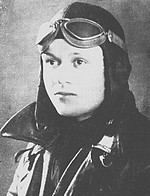
Józef Prętkowski
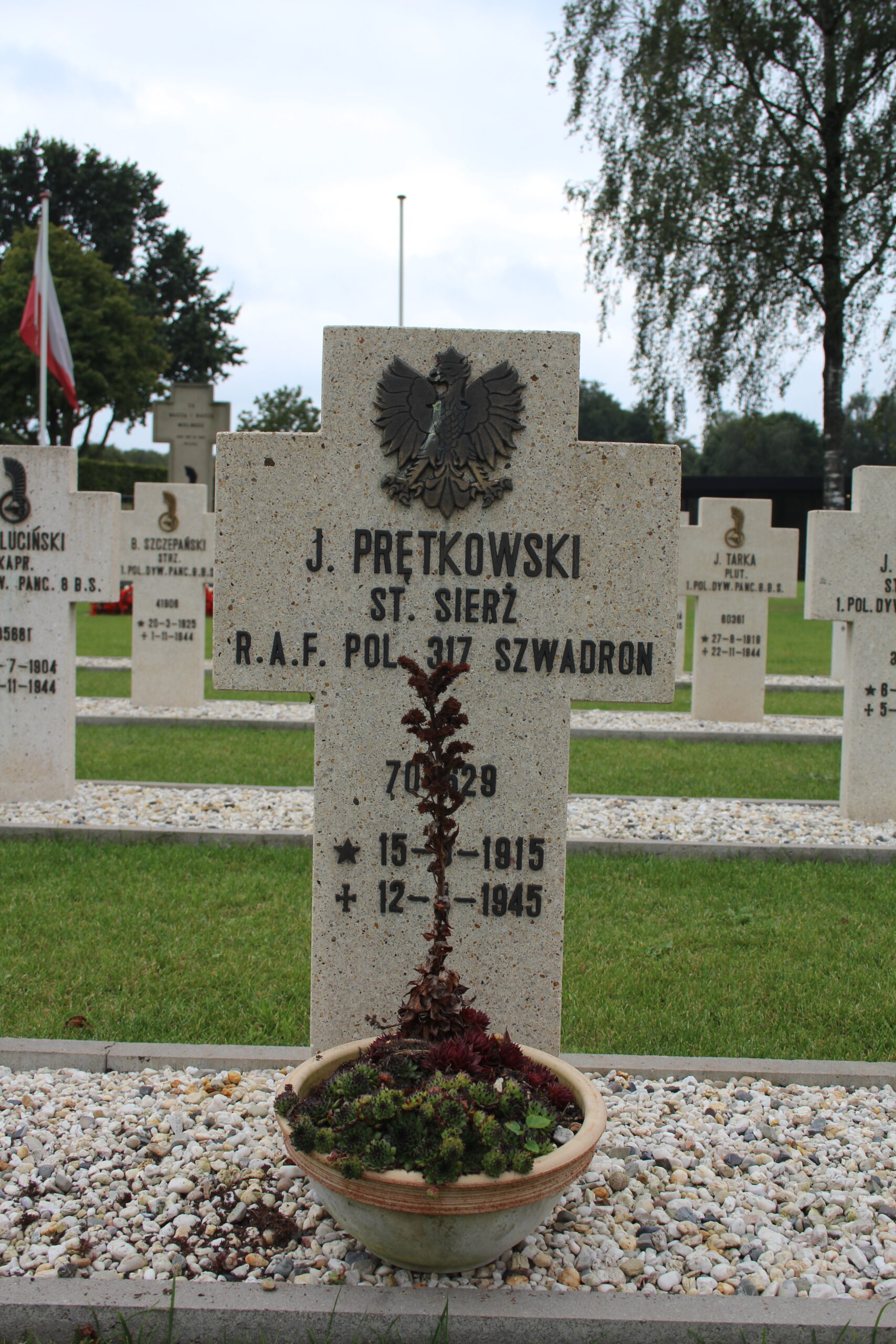
Often, a story about a fallen airman starts with the loss register. It reports that Józef Prętkowski crashed near the Kistemaker family farm on Dorpstraat in Abbekerk. It is thanks to extensive research by Frits van der Starre that we know much more about Józef Prętkowski. He began his investigation in 1995 when a headstone was discovered in the church tower of Abbekerk, which had been on the airman’s grave until he was reburied in Breda. It is his text and extensive visual material that form the backbone of this article. Many thanks for allowing us to draw from it to tell Józef Prętkowski’s story here
Pilot in Poland
Józef was born in 1915 into a Polish family in Kostrzyn, a town east of Poznań in the Wielkopolska province (Greater Poland). At that time, Poland was still partitioned between the German Empire, Tsarist Russia, and the Austro-Hungarian dual monarchy. Thus, Polish men could serve in the German, Russian, or Austrian army during World War I.
At age 14, Józef started working at the “Zgoda” cooperative in Kostrzyn. He was a member of the Catholic youth association “For Young Men,” a paramilitary group preparing boys for military service.
In 1936, Józef Prętkowski entered service as a conscript with the 69th Infantry Regiment in Gniezno. As an instrument maker, he was trained as a non-commissioned officer and machine gunner in Lida. He was assigned to the 5th Air Regiment and given the opportunity to undergo pilot training, completed in 1939. His base was at Pulanka near Wilno.
On September 1, 1939, war broke out. The Germans invaded Poland from the west, and the Russians from the east on September 17. On that day, Józef Prętkowski and his squadron fled to neutral Lithuania to rebuild forces outside Poland.
Diary excerpt from Józef Prętkowski, September 17, 1939:
Around 4 a.m., I reluctantly get up. At 4:30 a.m., I walk onto the airfield. Chwalik lets me know we fly together. At 5 a.m., we take off. In formation, four aircraft in low flight: “Bogdan, Kretowicz, Paluszek, and me.” After the stormy night, we fly low; Paluszek veers to avoid the Vilnius radio mast, still bearing traces of yesterday’s disaster. We circle the city clockwise, waking it with our engines’ roar. We bid farewell to Vilnius. Second Lieutenant Chwalik gives me chocolate; we haven’t had breakfast. Over the Dzisnienski lakes, a formation of RWD-8 aircraft passes in V-formation. We approach the border, see the border guard and customs buildings. We cross the border. We look back toward Poland. We bid farewell to the homeland and all our loved ones left behind.
In Lithuania, the pilots were disarmed and, through Polish contacts in Lithuania, Latvia, and Estonia, tried to find work and income. Some Polish pilots escaped via Hungary to France and participated in the June battles there.
From Soviet Labor Camp to Great Britain
Józef Prętkowski’s story is like so many of our liberators: In August 1940, he was captured by the Soviets and forced to work under appalling conditions in a mine in Inta. He wrote about it himself:
“On August 8, 1940, I was arrested while illegally crossing the border and imprisoned in Baranowicze. Prison conditions were miserable. In a 30 m² cell, there were 168 people. No one even thought of sleeping. Food was tolerable given the circumstances. If someone had better clothes or food, they were robbed and beaten by gangs. Gangs were formed by thieves and Soviet soldiers.
In the coal mine near Inta, food was even worse than in prison. Output was surprisingly high. No salary; I got 28 rubles for the first month, then nothing until my release, as I earned less than the mandatory contribution for rearmament.”
When Germany attacked the Soviet Union, Poles and Soviets became allies. The Soviets released the surviving Poles.
“This changed after July 30, 1941. We felt stronger than the Russians, and authorities became less hostile. I was released on October 8, 1941. When I joined the Polish Army, I saw not only extreme poverty and misery in big cities but also in villages and smaller places. Marian Maciejzek, a doctor from Warsaw, kept up morale and helped all Poles in the camp.”
Some Poles joined the Soviet Army (which had about 400,000 Poles), others evacuated via the Middle East to join General Anders’ army (fighting in Italy and Monte Cassino) or ended up in Great Britain, like Prętkowski.
Józef traveled from Russia via Tashkent, Tehran, Suez to Palestine, where the first Polish units formed. He continued via Jerusalem, Suez, Mombasa, Durban, Cape Town, and Brazil to Scotland. On December 1, 1942, Józef Prętkowski set foot in Great Britain, receiving registration number P-704629 in Blackpool.
Pilot on the Western Front
In England, he trained in Blackpool, Hucknall, and Brighton. Hucknall had two centers: No. 25 (Polish) Elementary Flying Training School and No. 16 (Polish) Service Flying Training School (later moved to Newton); full training took two years. Most Poles were experienced pilots. Learning English, commands, air combat strategy, bombing, Spitfire and Hurricane techniques took time. Through these centers, Polish pilots were assigned to Polish fighter squadrons.
His diary shows he wasn’t always happy in England. He was regularly examined for injuries from Russian camps. He corresponded with his fiancée Walentyna Kopcynska in Poland via addresses in Lisbon/South America. Besides these letters, he drafted a farewell letter to his mother in case he was killed, regretting he couldn’t care for her in old age.

On February 7, he became a pilot with Dywizjon 317.

317 Dywizjon Myśliwski „Wileński” / “City of Wilno”
Formed February 22, 1941, at RAF Acklington, operational by April 24. Initially equipped with Hurricane Mk.I, replaced by Mk.II in July 1941.
From October 1941 is was equipped with Spitfire Mk V, from September 1943 Mk IX.

In June 1943, the squadron is assigned to 2nd Tactical Air Force for air support to Allied ground forces after D-Day. Pre-Normandy, it flies intensive offensive operations over occupied Europe to weaken Luftwaffe and hit strategic targets.
Post-D-Day, it shifted to ground attacks supporting Allies. In August 1944, moved to continent for West Europe liberation.

In spring 1945 the squadron operated from B77 Glize-Rijen
Missions over the Netherlands
From Józef’s logbook, in April 1944 they flew several “armed reconnaissance” missions, including April 10 and 11. Imperial War Museum website has “gun camera” footage from those dates (see below). Logbook notes April 10 near Nijkerk.

On the morning of April 12, Józef Prętkowski took off at 10:10 from Gilze-Rijen (liberated south Netherlands) with three others for “Armed Recce.”
The ‘red wing’ consists of:
- W/O Jan Pawel Gajeski (1919-1985) JH-Y
- F/Lt Bronis Mach, wingleader (1918-2000) JH-T
- F/O Adam Ostrowski (1919-2018) JH-W
- F/Sgt Jόzef Prętkόwski (1915 – 1945) JH-V


picture 1, 2 and 3 Lysta Krysta, 4 Sikorski Institute via v.d. Starre
Józef flew Spitfire LF.IX ML421 JH-V. On this fateful April 12, his aircraft was hit by FLAK near Kolhorn over North Holland. With a failing engine, he crashed near Abbekerk.
Workers, some in hiding, saw the plane and ran for cover. It crashed where they stood moments before, breaking into pieces in tulip fields; engine block slid toward the new road. Jan Bobeldijk and Johan de Heus were repairing clogs in the workshop; they saw it slam behind Piet Kistemaker’s farm on Dirk Haker’s land. Barber Gerritsen and baker Johan van der Oord saw it going down.

Hider Piet Burger described:
“On April 12, Jaap Leeuw and I were tending tulips planted by my father. Sky covered in low clouds. Planes overhead. Flak from Schagen direction. Suddenly, a plane in trouble; couldn’t see it, engine cut out, restarted, then silent. It emerged from clouds gliding, big turn straight at us! We ran a few meters and dove into a ditch! It hit meters ahead, raced where we stood. If not run, we’d be dead.
It slid far, breaking apart. When still, we approached; found pilot on back, unburnt, seemingly not badly hurt—but dead. His group dove low to check. I stood by body, made cross sign overhead to show dead. They understood, dipped wings in salute. Jaap took some items. We left before Germans arrived.”
The other three pilots are back at base at 12:00. Whether from the cross sign or by their own observation, they drew the conclusion that Pretkowski died. ‘Operations Record Book’ states: “Shot down by Enemy Flak, and crashed on Enemy Territory. Pilot Missing, believed killed”.

Items taken: papers and pistol. Post-war, crankshaft from Rolls Royce Merlin, gun camera, compass surfaced.


ID card en de verschillende objecten (via v.d. Starre)
The body is taken to the church morgue. Locals made a coffin and buried the pilot the next day in grave 99. The cross at the picute below (via van der Starre) from 1946 was later replaced by headstone that sparked Frits van der Starre’s research into the story of Prętkowski.

In 1962, Józef Prętkowski is reburied in Breda. The rediscovered headston became a monument in Abbekerk cemetery.
Ties to Kostrzyn
Józef’s death not the end. In 1946, his mother contacted Mayor Krom of Abbekerk, thanking for grave care and anual commemorations on May 4th.
The rediscovery led the school to adopt the headstone and Frits is asked to do research into the history of this pilot. Next to this story, objects surfaced and ties formed between Abbekerk and Kostrzyn.
In 2015 the headstone is replaced by a speciaal designed monument (also remembring Flight Sgt. F.B. Tipper of 115 Squadron). The headstone was transferred to Kostrzyn where is found its place next to the local monument for WWII fictims.


Headstone in Poland en the new monument (via v.d. Starre)
Ook de persoonlijke bezittingen vinden hun weg terug naar nazaten en zijn nu te zien in een lokaal museum. Zijn naam wordt verder geëerd met een straatnaam en een plaquette. Daarmee wordt Józef herdacht in Abbekerk en Kostrzyn.

Meer lezen of bekijken?
Op Polen in Beeld staat een relaas van de parachutist Józef Wojciechowski die ook via de Sovjet Unie in het westen terecht kwam.
Op de website van het Imperial War Museum zijn beelden te vinden van de ‘gun camera’ gemaakt op 10 en 11 april. Een dag later crasht hij. Ze zijn te zien bij tijdcode 29:10 en tijdcode 31:43:


Stills (links van 10-4, omgeving Nijkerk? en rechts van 11-4) uit de film waaruit blijkt dat Józef Prętkowski de dag voor zijn dood nog aanvallen uitvoerde op gronddoelen in Nederland. Bekijk de film – ook met beelden van andere Poolse vliegers – op de site van het IWM.
Frits van der Starre
Zoals in het begin van het artikel vermeld hebben we veel informatie ontvangen van de heer Frits van der Starre die uitgebreid onderzoek heeft gedaan. Mocht u in contact met hem willen komen dan kan dat via fritsvanderstarre@planet.nl .